Since Albert R. Roche introduced the first hydraulic braking system in 1921—significantly improving vehicle stopping power—automotive braking technology has evolved for over a century. During this time, mechanical components across the vehicle have steadily given way to electronic systems. Mechanical throttle cables have been replaced by electronic throttle control, wax-based thermostats by electronically controlled valves, and viscous cooling fans by electric cooling systems.
However, when it comes to safety-critical subsystems—most notably steering and braking—mainstream passenger vehicles have historically retained mechanical architectures due to their perceived reliability and fail-safe characteristics.
The Shift Begins: From Mechanical Linkages to Full Electronic Control
That paradigm is starting to change.
Early adopters are already redefining what’s possible. For example, the Tesla Cybertruck eliminates the mechanical linkage in its steering system, replacing it with steer-by-wire. Braking systems, long considered the final stronghold of mechanical design in automotive platforms, are now on a similar trajectory.
Skepticism toward brake-by-wire (BBW) is understandable—after all, braking is directly tied to occupant safety. Yet from an engineering perspective, this transition represents a clear technological advancement. The key question is no longer if brake-by-wire will proliferate, but how its differences translate into real-world value for drivers.
Architecture Comparison: Hydraulic vs. Brake-by-Wire
Conventional Hydraulic Braking
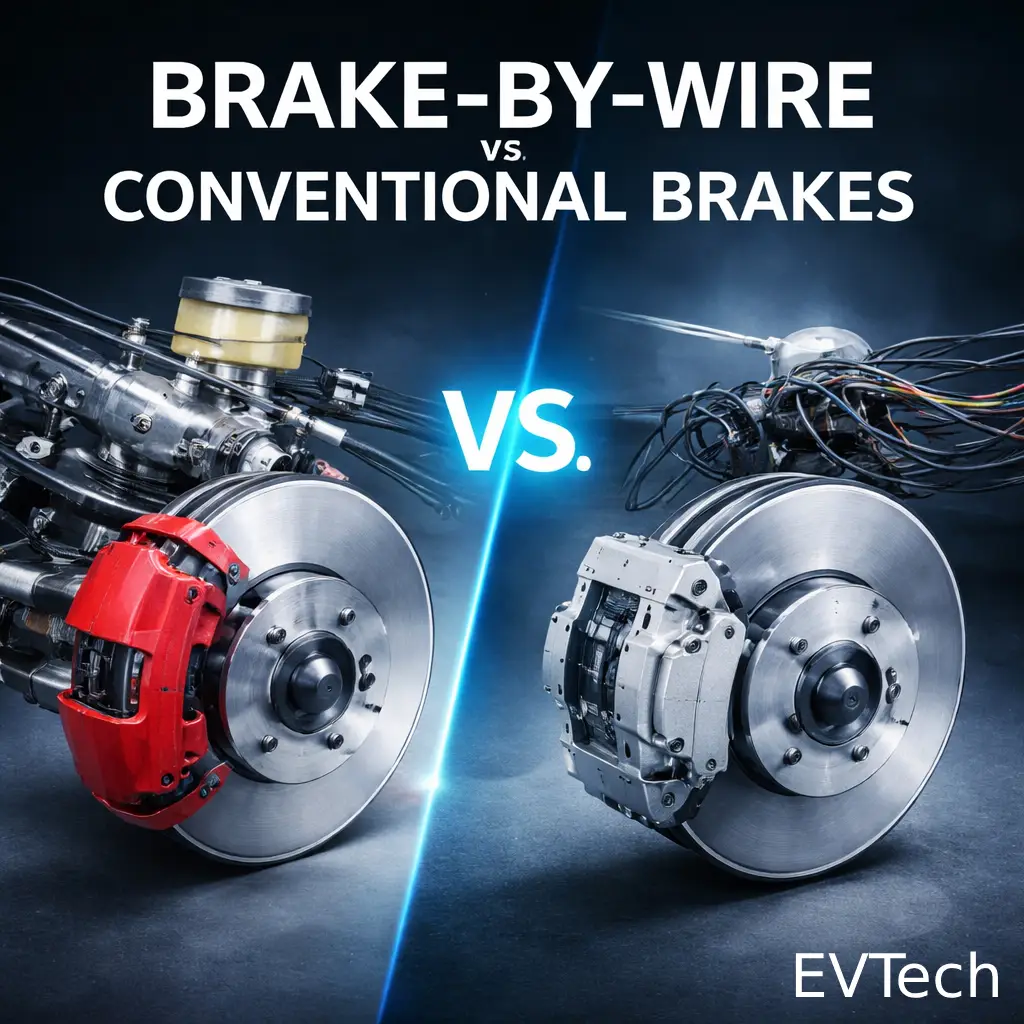
Traditional systems rely on hydraulic pressure generated by the driver’s pedal input. Through brake fluid, boosters, and the principles of Pascal’s Law, force is amplified and transmitted to the brake calipers, which clamp the brake discs.
This architecture requires:
- Brake fluid and reservoir
- Brake booster (vacuum or electric)
- Hydraulic lines and hoses
- ABS pump and control modules
Fully Dry Brake-by-Wire Systems
In contrast, a fully electromechanical brake-by-wire system eliminates the hydraulic domain entirely. There is no brake fluid, no master cylinder, no hydraulic lines, and no ABS pump in the traditional sense.
Instead, the system consists of:
- A central ECU controlling all four wheels
- Electrically actuated brake calipers
- Signal wiring replacing hydraulic lines
Each caliper integrates electric motors that directly drive the piston via gear mechanisms, clamping the brake disc without any hydraulic intermediary.
Immediate benefits include:
- Reduced system weight
- Simplified packaging
- Elimination of brake fluid maintenance
Response Time and Safety Implications
One of the most significant performance advantages of brake-by-wire lies in response time.
Hydraulic systems inherently require time to build pressure, and flexible brake lines introduce additional delay due to expansion under load. In typical passenger vehicles, this results in approximately 300 ms (0.3 s) of braking latency.
At 100 km/h, that delay translates to roughly 8.3 meters of additional travel before braking begins.
By contrast, brake-by-wire systems can reduce response time to approximately 75 ms (0.075 s)—cutting the delay distance to around 2 meters. From a physics standpoint, this improvement directly enhances active safety margins.
Safety Engineering: Mechanical Reliability vs. Redundant Electronics
A common argument is that “mechanical systems are inherently more reliable.” While this perception persists—especially given their widespread use in military vehicles—it oversimplifies the engineering reality.
The real differentiator is not mechanical vs. electronic, but redundancy architecture.
Hydraulic System Redundancy
Traditional braking systems employ dual-circuit hydraulic designs:
- One circuit controls the front-left and rear-right wheels
- The other controls the front-right and rear-left wheels
This ensures that even in the event of a partial system failure, approximately 50% braking capability is retained.
Brake-by-Wire Redundancy
Modern BBW systems implement multi-layered redundancy:
- Dual Power Supply Architecture
Separate power domains control diagonal wheel pairs, ensuring continued operation if one power source fails. - Dual Motors per Caliper
Each brake caliper contains two independent electric motors. If one fails, the other can still generate braking force. - Distributed ECUs
In addition to a central ECU, each caliper may include a local controller, enabling wheel-level fallback control even if the central unit fails.
From a systems engineering standpoint, brake-by-wire can exceed the redundancy of hydraulic systems—provided it is properly designed and validated. Ultimately, reliability depends less on system type and more on implementation quality, cost targets, and OEM engineering standards.
Beyond Safety: What Does This Mean for Drivers?
The most compelling advantage of brake-by-wire isn’t just faster response—it’s control flexibility.
With fully independent control at each wheel, entirely new driving dynamics become possible:
- Dynamic Torque Vectoring via Braking
Adjust braking force per wheel in real time to enhance cornering stability and agility. - Advanced Cornering Control
Instead of relying on techniques like “gutter driving” popularized in motorsports culture, vehicles can automatically increase braking force on the inner wheel during high-speed cornering. - Zero-Radius Turns / Pivot Steering
By precisely controlling wheel-level braking, vehicles could theoretically execute tight turning maneuvers without complex mechanical systems. - Enhanced Off-Road Capability
Instant braking of slipping wheels can simulate differential locking—improving traction without traditional four-wheel-drive hardware.
These capabilities align closely with the broader shift toward software-defined vehicles, where driving characteristics are increasingly governed by algorithms rather than hardware constraints.
Remaining Challenges
Despite its promise, brake-by-wire still faces practical limitations:
- Brake Fade Feedback
In hydraulic systems, thermal fade is partially communicated through pedal feel. In BBW systems, this feedback must be artificially synthesized. - Thermal Management
Brake discs and pads still generate heat, and managing thermal degradation remains critical under aggressive driving conditions. - Driver Trust and Adoption
As with any safety-critical innovation, user confidence will take time to build.
Final Thoughts: Technology Validation Through Performance
Evaluating automotive technology purely through theory can be misleading. A more pragmatic benchmark—often overlooked—is motorsport validation.
If a technology consistently performs under extreme conditions, across diverse racing environments, and over time, it proves its engineering merit.
In the end, the equation is simple: performance, reliability, and time are the ultimate arbiters of automotive innovation.