You’ve likely heard of the four major power-sharing features in modern Electric Vehicles (EVs): V2L, V2V, V2H, and V2G. Of these, V2L is the one you probably encounter most often. To help you get the most out of your EV’s capabilities, let’s explore exactly what these functions do and how they differ.
While they all involve sharing power, their applications vary significantly. A key technical distinction is that V2L typically operates via slower AC charging, whereas V2V, V2H, and V2G are designed for high-speed DC charging. Furthermore, V2L is unidirectional (one-way), meaning it only sends power out from the car. In contrast, the other three are bidirectional, allowing for two-way communication and energy flow. As you might expect, the equipment requirements and costs for these features vary as well.
◉ V2L: Vehicle-to-Load
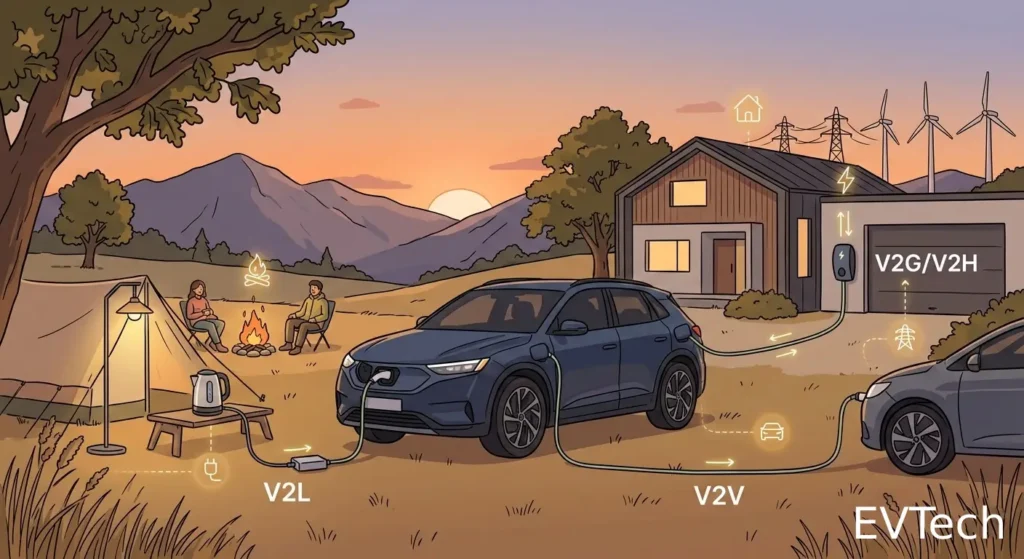
V2L uses the vehicle’s onboard charger to convert DC power from the traction battery into 120V/220V AC power. By using a power adapter, you can plug in standard household electronics directly into your car. This is a massive selling point for outdoor enthusiasts; it turns your EV into a mobile power bank for camping, tailgating, or picnics, powering everything from laptops and lights to electric grills and speakers.
How it works: In “Inverter Mode,” the DC power from the battery passes through a switching circuit (utilizing IGBTs and MOSFETs). By precisely controlling these components, the system converts DC into high-frequency AC that matches the voltage and frequency of a standard wall outlet. High-efficiency inverter technology ensures minimal energy loss, with output often reaching several kilowatts—plenty of power for a kettle, induction cooktop, or hair dryer. Thanks to the synergy between the VCU (Vehicle Control Unit) and OBC (Onboard Charger), the system is “plug-and-play,” automatically adjusting output based on the device’s needs.
◉ V2V: Vehicle-to-Vehicle
V2V allows one EV to charge another. This system relies on a bidirectional onboard charger or MCU and a specialized bidirectional charging cable. It serves as a “mobile jumpstart” for the electric age. If an EV runs out of juice, a second vehicle can connect to it and transfer energy directly from battery to battery. This provides a crucial safety net for long road trips or travel in remote areas where charging stations are scarce.
◉ V2G: Vehicle-to-Grid
V2G is a smart interaction between the EV and the public power grid. It allows vehicles to feed electricity back into the grid during peak demand hours and pull power to charge during off-peak hours (when rates are lower).
This technology is a game-changer for grid stability, acting as a flexible energy storage solution—especially in regions with high levels of renewable energy like wind or solar. To make V2G a reality, the vehicle needs a bidirectional charger and a Smart Grid interface to ensure secure data exchange between the car and the utility provider. V2G pilot programs are already rolling out globally with promising results.
◉ V2H: Vehicle-to-Home
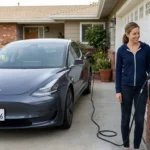
V2H treats your car as a backup battery for your house. It allows the vehicle to power your home’s appliances during a blackout or peak-rate periods, while also allowing the car to recharge from the home’s supply when needed.
Implementing V2H requires a bidirectional charger and an inverter, along with a dedicated home interface and safety transfer switch. While commercial adoption is still scaling, countries like Japan and South Korea have already made significant strides in integrating V2H into the modern smart home.
The Bottom Line
The evolution of V2X (Vehicle-to-Everything) technology depends on a mix of robust hardware and intelligent software. These features don’t just make EVs more versatile; they transform them into active participants in our energy ecosystem. As these technologies become standard, they will drive the adoption of clean energy and provide us with more sustainable, efficient ways to power our lives.