1. Definition of Thermal Runaway
Thermal Runaway (TR) refers to a self-accelerating chain reaction that can occur in lithium-ion batteries under abnormal operating conditions. During this process, the cell temperature rises rapidly while internal pressure increases due to gas generation from electrochemical and chemical reactions.
If the reaction cannot be contained, the cell may vent, ignite, or in extreme cases explode.
Thermal runaway is therefore considered one of the most critical failure modes in lithium-ion battery systems and is a key focus area in modern electric vehicle battery safety design.
2. Thermal Runaway Mechanism
Thermal runaway can be understood as a cascade of thermally driven chemical reactions.
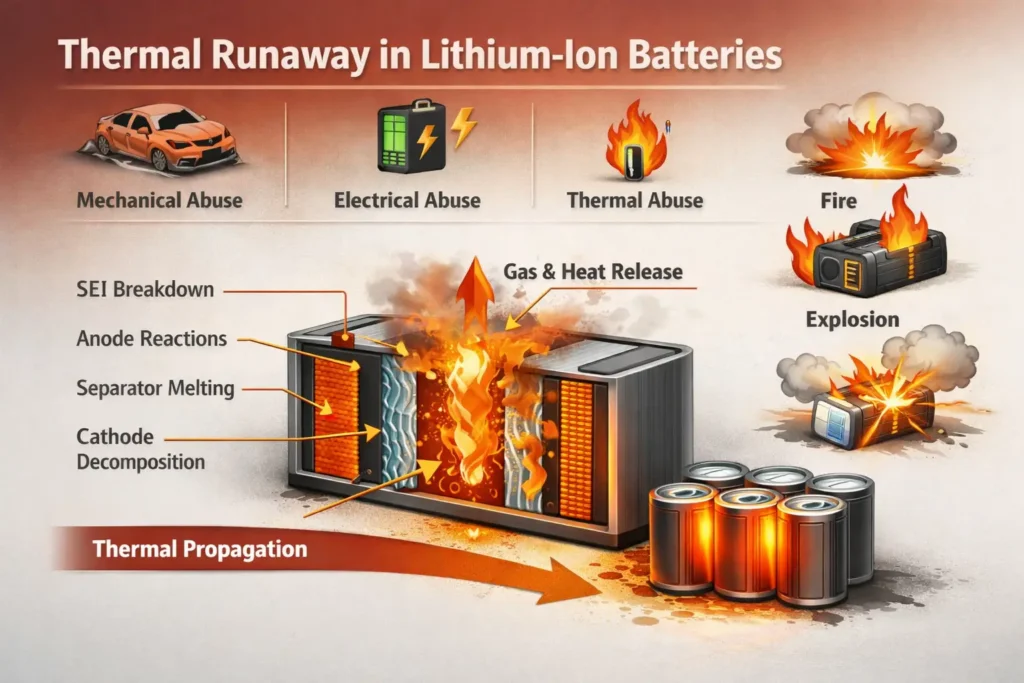
Under abuse conditions, once the cell temperature rises beyond a critical threshold, a sequence of exothermic reactions begins. These reactions create a Heat–Temperature Reaction (HTR) feedback loop, where increasing temperature accelerates chemical reactions that release even more heat.
The typical reaction sequence during temperature rise includes:
- SEI (Solid Electrolyte Interphase) decomposition
- Reactions between the anode and electrolyte
- Melting or shrinkage of the polyethylene (PE) separator matrix
- Decomposition of the NCM cathode material
- Electrolyte decomposition and gas generation
Once the separator coating collapses or melts, large-scale internal short circuits can occur. This event can instantaneously release the stored electrical energy of the cell, dramatically increasing temperature and triggering full thermal runaway. At this stage, the electrolyte may ignite due to the high temperature and presence of flammable gases.
The overall process is characterized by rapid heat release and exponential temperature escalation, making early detection and mitigation essential for system safety.
3. Root Causes of Thermal Runaway
Thermal runaway events are typically categorized into three major abuse conditions:
Mechanical Abuse
Mechanical damage—such as vehicle collisions, cell deformation, or puncture—can compromise the internal structure of the battery, leading to internal short circuits.
Electrical Abuse
Electrical abuse occurs when the battery operates outside its safe electrical limits, including:
- Overcharging
- Over-discharging
- High current caused by internal short circuits
These conditions can generate excessive heat and push the cell beyond its thermal stability limits.
Thermal Abuse
Thermal abuse occurs when the battery is exposed to temperatures above its safe operating range. This may result from:
- Failure of the vehicle’s thermal management system
- Heat propagation from a neighboring cell undergoing thermal runaway
From a failure analysis perspective, the causes of thermal runaway can also be classified as internal triggers and external triggers.
- Internal triggers originate from manufacturing defects, contamination, or internal structural failures within the cell.
- External triggers arise from mechanical, electrical, or thermal stresses applied from outside the cell.
Regardless of origin, the final failure mechanism typically involves internal short circuits, which initiate the runaway reaction.
4. Thermal Runaway Prevention Strategies
Effective thermal runaway mitigation requires a multi-layer safety strategy, spanning materials, cell design, and battery system architecture.
Material-Level Design
Material selection plays a critical role in improving intrinsic battery safety.
- Cathode materials: Selecting materials with optimized lithium content and improved thermal stability. For example, layered ternary cathodes can be enhanced through surface coatings that increase thermal stability.
- Anode materials: Using materials with lower flammability or applying surface treatments and electrolyte additives to stabilize the SEI layer.
- Separator and electrolyte: Choosing separators with higher melting temperatures and electrolytes with improved thermal stability.
Cell-Level Design
Cell safety can be improved through advanced manufacturing processes and structural design, including:
- Improved electrode coating uniformity
- Contamination control during manufacturing
- Robust separator design
- Built-in safety mechanisms such as current interrupt devices (CID)
Battery System-Level Design
At the system level, safety is achieved through mechanical protection, thermal management, and electronic monitoring:
- Battery modules designed with high-voltage identification and protective labeling
- Ingress protection (IP67) for water and dust resistance
- Use of vibration- and impact-resistant flame-retardant enclosure materials
- Dedicated wiring harness and integrated electrical architecture
- Optimized thermal management strategies to control cell temperature distribution
- A comprehensive Battery Management System (BMS) that provides:
- Overvoltage protection
- Overcurrent protection
- Overtemperature protection
- Insulation monitoring
- Early thermal runaway warning and fault mitigation
Key Takeaway
Thermal runaway is not the result of a single failure mechanism, but rather a complex interaction between electrochemical reactions, thermal dynamics, and mechanical structure.
Mitigating this risk requires end-to-end engineering across materials, cell design, and system architecture, combined with intelligent monitoring and control.
As battery energy density continues to increase in modern electric vehicles, thermal runaway prevention and containment remain central challenges in battery safety engineering.