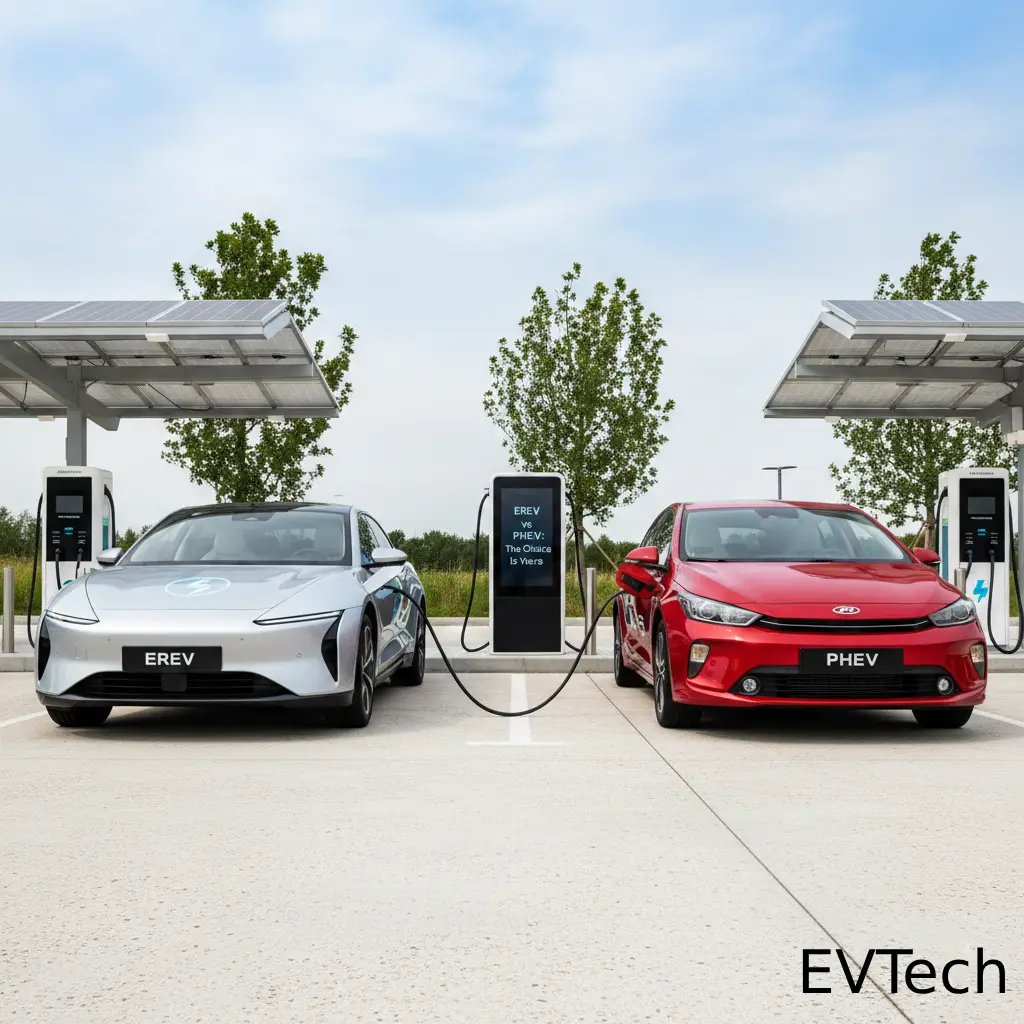
In the rapidly growing EV market, Extended-Range Electric Vehicles (EREV) and Plug-in Hybrid Electric Vehicles (PHEV) are two of the most popular options. While both combine electric motors with gas engines, they differ significantly in how they operate, how they feel behind the wheel, and how much they cost to own.
So, what exactly sets them apart?
1. How They Work
EREV (Extended-Range Electric Vehicle): An EREV is essentially an electric car that carries its own portable generator. The wheels are always driven by the electric motor. The gas engine never physically connects to the wheels; its only job is to spin a generator that recharges the battery when it gets low.
- Pros: You get a 100% electric driving experience at all times. Even when the battery is low, the “range extender” keeps you moving without range anxiety.
- Cons: Because the gas engine is only used to generate electricity (rather than driving the wheels directly), it can be less fuel-efficient than a hybrid on long highway trips.
PHEV (Plug-in Hybrid Electric Vehicle): A PHEV is a “dual-threat” vehicle. It has both an electric motor and a gas engine that can both power the wheels. You can switch between an All-Electric mode and a Hybrid mode.
- Pros: PHEVs are highly efficient. On long trips, the gas engine can take over or assist the motor at high speeds where it’s most efficient.
- Cons: The mechanical systems are more complex because the car has to manage two different power sources driving the wheels.
2. The Driving Experience
- EREV: Since the wheels are always powered by electricity, the ride is smooth, quiet, and provides instant torque—just like a Tesla or other pure EVs. You rarely notice when the gas generator kicks in.
- PHEV: In electric mode, it feels like an EV. However, in hybrid mode, you may feel or hear the gas engine engage, especially during hard acceleration or at highway speeds.
3. Range and Fuel Economy
- EREV: Typically offers a larger battery with an all-electric range of 60 to 120 miles. With the gas generator, the total range can easily exceed 300 to 500 miles, comparable to a traditional gas car.
- PHEV: Usually has a smaller battery, providing 30 to 60 miles of pure electric range. However, their total combined range is often higher—reaching 400 to 500+ miles—due to the efficiency of the hybrid powertrain.
4. Cost and Maintenance
- EREV: * Upfront Cost: Usually higher due to the larger battery pack.
- Maintenance: Generally lower. Since the gas engine isn’t under the same stress as a primary drive engine, it suffers less wear and tear.
- PHEV: * Upfront Cost: Often more affordable because the battery is smaller.
- Maintenance: Can be higher over time because both the electric and gas drive systems require regular servicing.
5. Best Use Cases
- EREV: Perfect for drivers who want the “EV lifestyle” and smooth performance but occasionally take long road trips where charging stations might be scarce.
- PHEV: Ideal for commuters who can do most of their daily driving on electricity but want maximum fuel efficiency and a familiar “hybrid” feel for long-distance travel.
Summary
Choosing between an EREV and a PHEV comes down to your driving preference. If you want a pure electric feel without ever worrying about a dead battery, go with an EREV. If you want a versatile, efficient hybrid that can still handle your daily commute on battery power, a PHEV is likely your best bet.