Feature Overview and Comparison
You may have heard of the “Big Four” in modern EV technology: V2L, V2V, V2H, and V2G. Among these, V2L (Vehicle-to-Load) is likely the one you encounter most often. To help you navigate the evolving EV landscape, let’s take a deep dive into what these acronyms actually mean for you.
While they all fall under the “Vehicle-to-Everything” (V2X) umbrella, each serves a distinct purpose:
- Charging Types: V2L typically uses AC slow charging, whereas V2V, V2H, and V2G are designed for DC fast charging applications.
- Directionality: V2L is unidirectional (one-way), meaning it only discharges power to external devices. In contrast, V2V, V2H, and V2G feature bi-directional communication and power flow.
- Cost and Equipment: There are significant differences in the hardware requirements and price points for implementing each of these features.
◉ V2L: Vehicle-to-Load
V2L uses the vehicle’s onboard charger (OBC) to convert DC power from the traction battery into standard AC power (typically 120V or 240V in the U.S.). By using a simple power adapter, your EV becomes a massive mobile power bank.
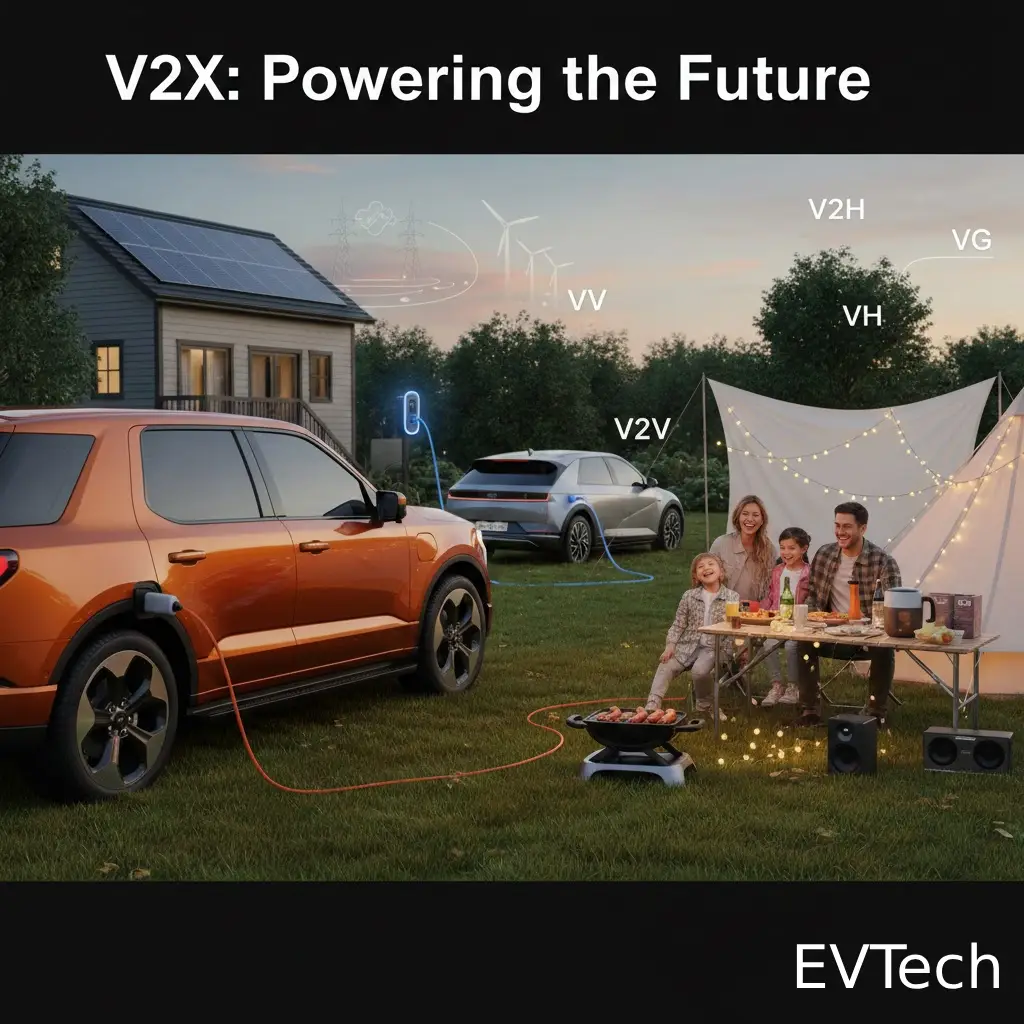
Automakers frequently highlight V2L for outdoor lifestyles. Whether you’re camping, tailgating, or having a backyard cookout, V2L easily powers lights, coffee makers, electric grills, and even high-end audio systems.
How it works: In “inverter mode,” the DC power from the battery passes through a switching circuit (utilizing IGBTs and MOSFETs). This circuit precisely regulates the current to match the voltage and frequency of a standard wall outlet. High-efficiency conversion technology allows for output levels of several kilowatts—plenty of power for high-draw appliances like kettles, hot plates, and hair dryers. Thanks to the coordination between the VCU (Vehicle Control Unit) and OBC, the system is “plug-and-play,” automatically adjusting output based on the load.
◉ V2V: Vehicle-to-Vehicle
V2V allows one EV to charge another. This system relies on a bi-directional OBC or MCU and a specialized V2V charging cable. It essentially turns an EV into a “rescue vehicle.” If a fellow driver runs out of juice, you can connect the two cars and transfer energy directly from your battery to theirs.
This technology is a game-changer for roadside assistance and peace of mind during long-distance road trips or in remote areas. However, V2V is currently limited to vehicles with compatible hardware and DC charging interfaces.
◉ V2G: Vehicle-to-Grid
V2G is an interactive power mechanism between the EV and the public utility grid. It allows EVs to sell power back to the grid during peak demand hours and recharge when demand (and prices) are low.
V2G is a vital tool for stabilizing the energy grid, especially in regions with high levels of renewable energy like wind and solar. To make V2G work, you need a bi-directional charger, a smart grid interface, and a robust Battery Management System (BMS) to ensure secure data exchange. While still in the pilot phase in many regions, its potential for large-scale energy management is massive.
◉ V2H: Vehicle-to-Home
V2H treats your car as a backup power source for your entire house. In this mode, your vehicle can power your home’s essential appliances during an outage and then recharge from the home’s supply once the lights are back on.
This requires a bi-directional charger, a dedicated home inverter, and a transfer switch to safely isolate the home from the grid during use. While commercial adoption is growing fastest in markets like Japan and South Korea, it is gaining significant traction in North America as a clean alternative to gas-powered backup generators.
Summary
The rise of V2X technology depends on a blend of robust hardware and “smart” software. These innovations don’t just make EVs more efficient; they transform the car from a simple mode of transport into a dynamic energy partner for your home and community. As these technologies become standard, the next generation of New Energy Vehicles (NEVs) will play a crucial role in promoting clean energy and protecting the environment.