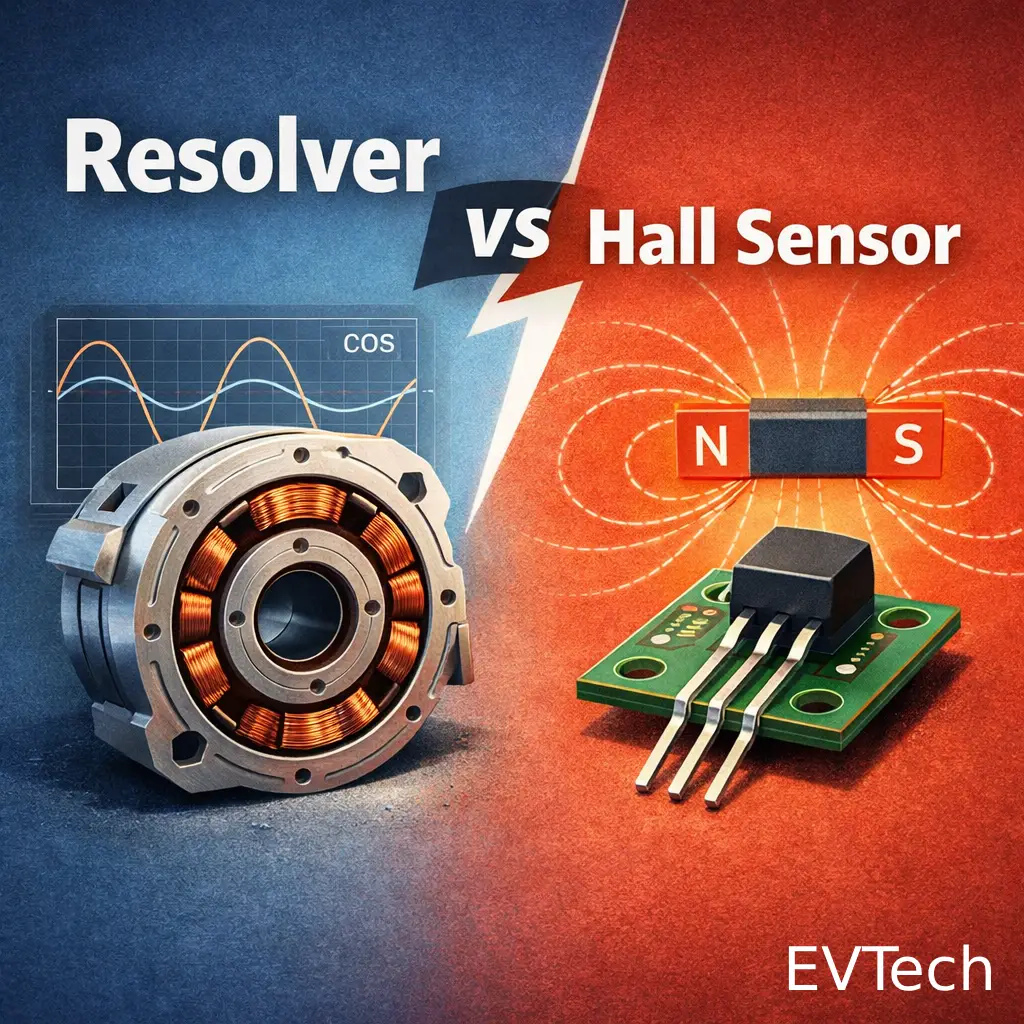
Before comparing performance, it’s important to understand how resolvers and Hall effect sensors actually work in a motor control system.
1. Resolver (Rotary Transformer)
A resolver is an electromagnetic position sensor based on the principle of inductive coupling. It is widely used for rotor position and speed measurement in permanent magnet synchronous motors (PMSMs), especially in electric vehicle (EV) traction systems.
How a Resolver Works
A resolver consists of two main parts:
- Stator windings (excitation / primary side)
- Rotor windings (secondary side)
The stator is driven by an AC excitation signal—commonly at 400 Hz, 3 kHz, or 5 kHz. Through electromagnetic coupling, the rotor windings generate induced voltages.
Unlike a conventional transformer, the relative angular position between stator and rotor windings continuously changes, which modulates the output signals. As a result:
- The resolver produces analog sine and cosine signals
- These signals are continuous functions of rotor angle
By applying an arctangent (atan2) operation to the sine and cosine signal envelopes, the system can compute absolute rotor position with high precision.
Key Advantages of Resolvers
Resolvers are known for:
- High accuracy and resolution
- Exceptional reliability (no active semiconductor at the sensing interface)
- Strong immunity to EMI, vibration, and contamination
- Wide operating temperature range
Because of these characteristics, resolvers can fully replace optical encoders in harsh environments and are widely deployed in:
- EV traction motors
- Servo drives and robotics
- CNC machine tools
- Aerospace and defense systems
- Industrial automation (metallurgy, oil & gas, mining, etc.)
2. Hall Effect Sensor
A Hall effect sensor is a semiconductor-based device that measures magnetic fields using the Hall effect.
Hall Effect Fundamentals
When charge carriers (electrons) move through a conductor in a magnetic field, they experience the Lorentz force, causing them to deflect. This creates a transverse voltage, known as the Hall voltage, which is:
- Proportional to magnetic field strength
- Proportional to current density
- Dependent on the material properties
How Hall Sensors Work
A typical Hall sensor system includes:
- A Hall element
- Signal amplification circuitry
- An output stage
When exposed to a magnetic field:
- The Hall element generates a small voltage
- The signal is amplified
- The system outputs either:
- Analog magnetic field data, or
- Digital switching signals (in switch-type Hall sensors)
In motor applications, digital Hall sensors typically provide discrete position signals (high/low states), corresponding to rotor position segments.
Why EV PMSMs Prefer Resolvers Over Hall Sensors
In modern electric vehicle PMSM drives, resolvers are the preferred rotor position sensing solution. The reasons are primarily tied to precision, robustness, and reliability under extreme conditions.
1. Higher Accuracy and Absolute Position Feedback
Resolvers deliver continuous, absolute position signals, enabling high-performance control algorithms such as field-oriented control (FOC).
Hall sensors, by contrast:
- Provide discrete position steps
- Suffer from angular quantization errors (e.g., 90°/N segmentation)
- Require multiple sensors embedded in stator windings to improve resolution, increasing system complexity
2. Superior Mechanical Robustness
Resolvers are fundamentally passive electromagnetic devices—constructed from copper windings and laminated steel.
- No fragile semiconductor elements at the sensing interface
- Excellent resistance to shock, vibration, and mechanical stress
Hall sensors, being semiconductor devices, are inherently more vulnerable to:
- Mechanical stress
- Aging and failure under harsh automotive conditions
3. Wide Temperature Capability (Automotive-Grade Reliability)
Automotive motor systems typically require operation across –40°C to +85°C ambient conditions.
However, in real-world EV traction motors:
- Internal motor temperatures can exceed ambient by 30°C to 100°C+ under high load
Resolvers can operate reliably under these extreme thermal conditions.
Hall sensors:
- Are limited by semiconductor junction temperatures
- Only a small subset of automotive-grade ICs can meet such requirements
- May face availability and cost challenges at higher temperature ratings
Final Takeaway
From an engineering standpoint, resolvers outperform Hall effect sensors in precision, environmental robustness, and long-term reliability. These advantages make them the default choice for rotor position sensing in modern EV PMSMs.
While Hall sensors remain viable for cost-sensitive or low-performance applications, resolvers are the clear winner in high-power, high-speed, and safety-critical systems—which is exactly where today’s electric vehicles operate.