
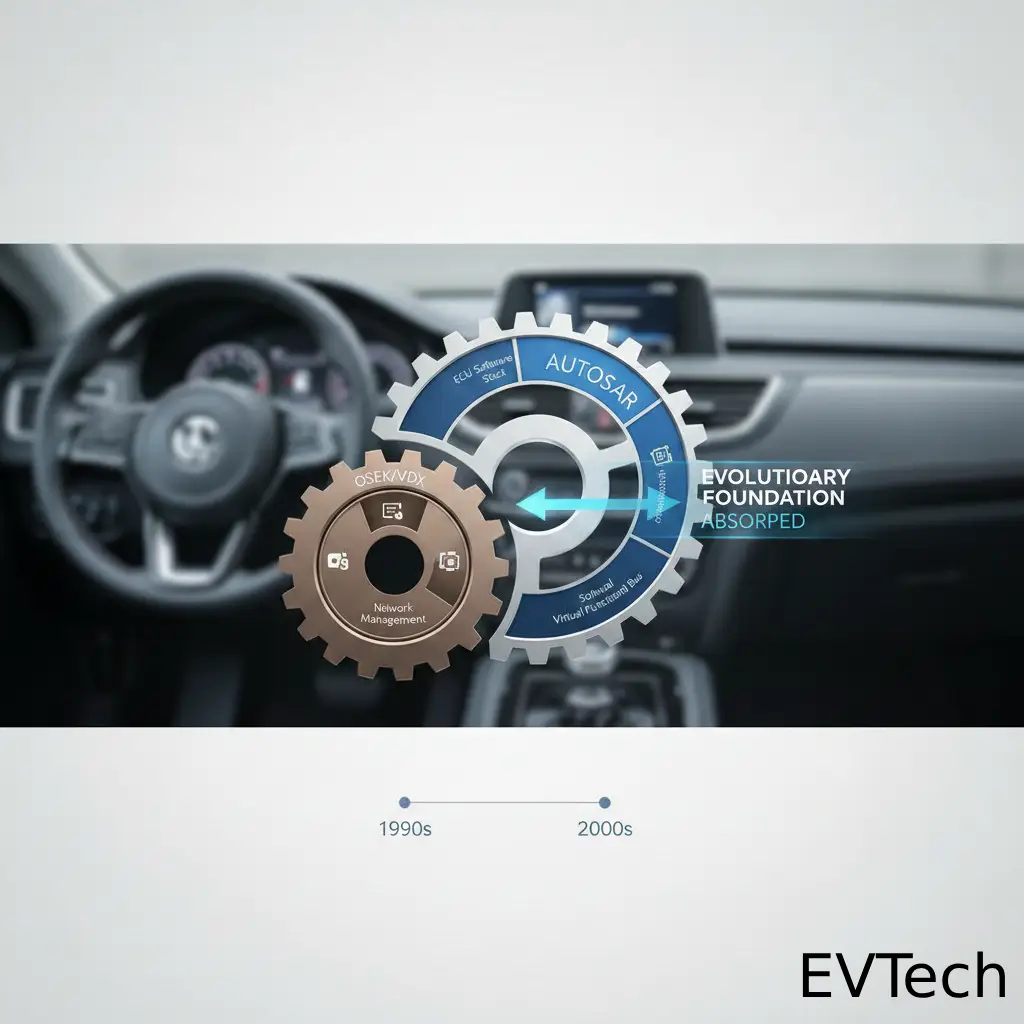
Both AUTOSAR and OSEK/VDX serve as industry standards for automotive electronic software. However, they differ in scope: OSEK/VDX is an operating system standard centered on ECU-level development, whereas AUTOSAR is a functional standard focused on the entire vehicle’s electronic ecosystem.
The OS standard defined within AUTOSAR is built directly upon OSEK/VDX. While AUTOSAR’s communication and network management protocols differ from OSEK’s, they share a clear lineage. Essentially, AUTOSAR evolved from OSEK/VDX, and the OSEK standard is effectively a subset of the broader AUTOSAR software architecture.
I. AUTOSAR (AUTomotive Open System ARchitecture)
AUTOSAR was developed to manage the surging complexity of modern E/E architectures caused by the proliferation of ECU units, making system development more flexible and efficient.
The AUTOSAR Alliance was founded in 2003 by industry giants—including BMW, Bosch, Continental, DaimlerChrysler, Volkswagen, and Siemens VDO—to establish a truly open architecture. Since then, the alliance has expanded to include OEMs, Tier 1 suppliers, semiconductor manufacturers, and tool providers worldwide. Today, the AUTOSAR standard is the roadmap for automotive E/E design.
The Core Objectives of AUTOSAR:
- Future-Proofing: Meeting demands for availability, safety, over-the-air (OTA) updates, and maintainability.
- Scalability: Enhancing software flexibility to streamline integration.
- Interoperability: Enabling Commercial Off-The-Shelf (COTS) software and hardware across different product lines.
- Risk Mitigation: Managing the complexity of products and development processes.
- Cost Optimization: Reducing long-term development expenses.
Key Technical Characteristics:
- Modularity and configurability.
- Standardized interfaces.
- The introduction of the Runtime Environment (RTE).
- Standardized testing specifications.
The Four Pillars of the AUTOSAR Standard:
- ECU Software Architecture (The layered stack).
- Software Components (SWCs).
- Virtual Functional Bus (VFB).
- Methodology (The standardized design workflow).
II. OSEK/VDX
To address the challenges of software portability and interface compatibility across diverse communication networks, the German automotive industry introduced OSEK in 1993. In 1994, it merged with the French VDX (Vehicle Distributed eXecution) standard from PSA and Renault.
By 1995, the industry reached a consensus, leading to the OSEK/VDX Specification in 1997. This specification consists of four primary components:
- OSEK OS: Operating System specification.
- OSEK COM: Communication specification.
- OSEK NM: Network Management specification.
- OIL (OSEK Implementation Language): For system configuration.
Since then, major software vendors have released OSEK-compliant products. As the standard matured, its structure and functionality were optimized through several versions. Standards such as OSEK OS 2.2 and OSEK COM 2.3 have since moved toward international ISO certification.
Key Technical Characteristics:
- Real-time performance: Optimized for safety-critical tasks.
- Portability: Facilitating code reuse across hardware.
- Scalability: Efficiently managing limited hardware resources.
Conclusion
While both are automotive standards, OSEK is ECU-centric, whereas AUTOSAR is vehicle-centric. Because the AUTOSAR OS is based on OSEK—and its communication modules follow the same fundamental logic—we view AUTOSAR as an evolution of OSEK. In the modern automotive landscape, OSEK is a core building block contained within the comprehensive AUTOSAR framework.



Wishing you a happy day, every day!