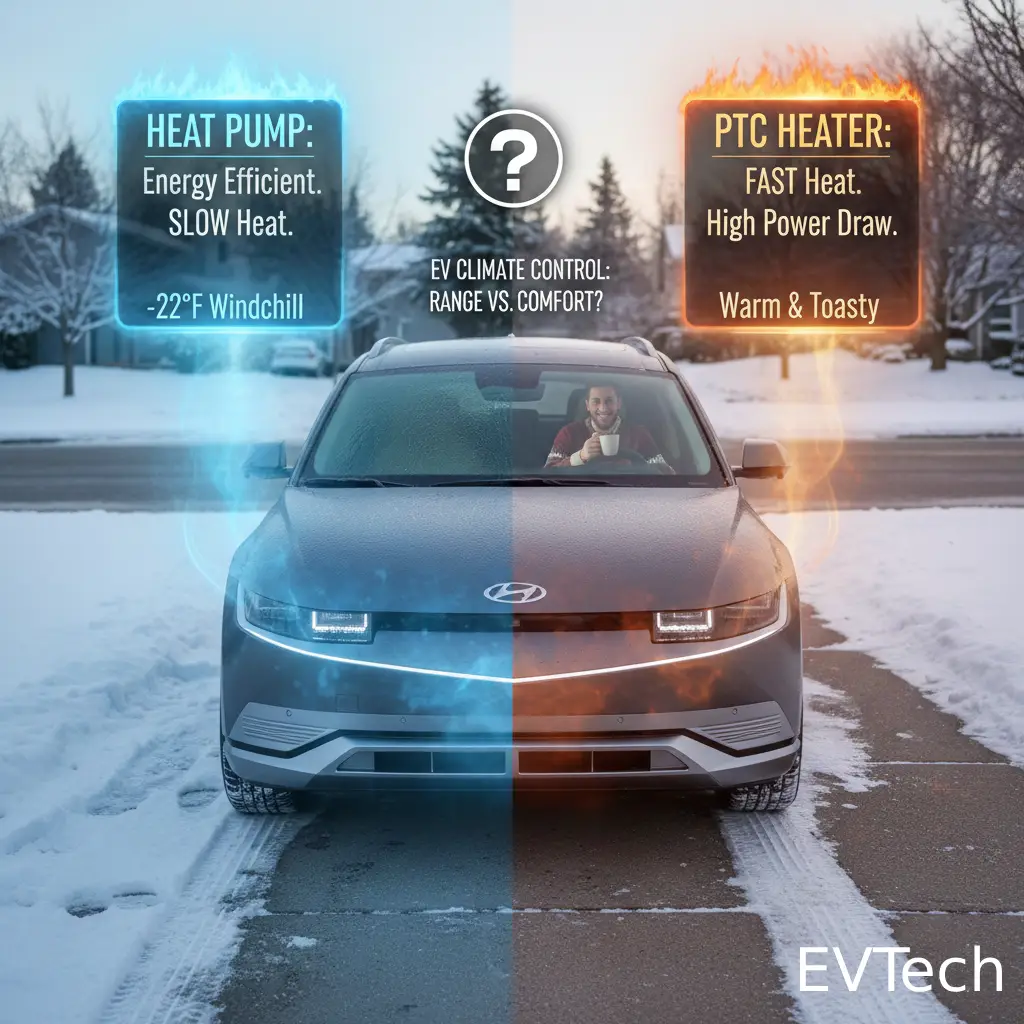
Running the AC has a massive impact on an EV’s range. You’ve probably noticed that in some cars, you’re freezing your tail off even with the heat on, while others get nice and toasty. This raises the big question: Which is better, a Heat Pump or a PTC heater?
How Heat Pumps Work
First, let’s look at cars equipped with heat pumps. From a range perspective, they are definitely superior.
However, I’ve heard many drivers complain that they’re “freezing to death” in heat pump-equipped cars. Why? Unlike a hair dryer or a PTC heater, a heat pump doesn’t actually generate heat. Instead, it acts like a reverse refrigerator, scavenging heat from the outside air and pumping it into the cabin.
If it’s -30°outside, there’s barely any ambient heat left to grab. The system has to work overtime to squeeze out every bit of warmth it can find. By the time that air reaches the vents, it might feel lukewarm at best. It takes forever to get the cabin up to a comfortable temperature, and in extreme cold, it might never hit your target setting.
The PTC Advantage
On the flip side, PTC heaters are much more straightforward. Think of them like a giant space heater.
When you kick it on, electricity flows through heating elements that get hot instantly. A fan blows air over these coils, and you get heat—fast. Within five minutes, your cabin is at a cozy 20°, and you’re ready to roll.
The downside? These things are total power hogs. To maximize range, many EV manufacturers are switching to heat pumps because they are significantly more energy-efficient in most scenarios.
Efficiency vs. Comfort
From my personal experience, when the mercury really drops, a heat pump just can’t match that “instant blast” of hot air you get from a PTC system. It feels slower and the air coming out of the vents just isn’t as “toasty.” This is exactly why some EVs feel underpowered in the winter.
So, which is better? If you prioritize efficiency, the heat pump wins in most climates. But if you live in a deep-freeze region, you have to ask yourself: do I want to save miles, or do I want to be comfortable?
For a pure EV, range is usually the priority. But for a Plug-in Hybrid (PHEV) or an EREV (Extended Range Electric Vehicle), I’d take the comfort. I’m okay with a little less electric range if it means I’m not “freezing like a dog” while I drive.
The Bottom Line
When you’re car shopping, don’t just look at one spec or one test result. You need to consider your specific environment. Talk to friends who own these cars and get their “real world” feedback.
There is no “perfect” system—only the one that fits your climate. It’s all about the trade-off between range and comfort.