What Exactly is an EV Drive System?
At the center of every electric vehicle pulses its “heart”—the electric drive system. It is the powerhouse of the vehicle. For Battery Electric Vehicles (BEVs), the drive system is the sole source of propulsion, completely replacing the internal combustion engine found in traditional cars.
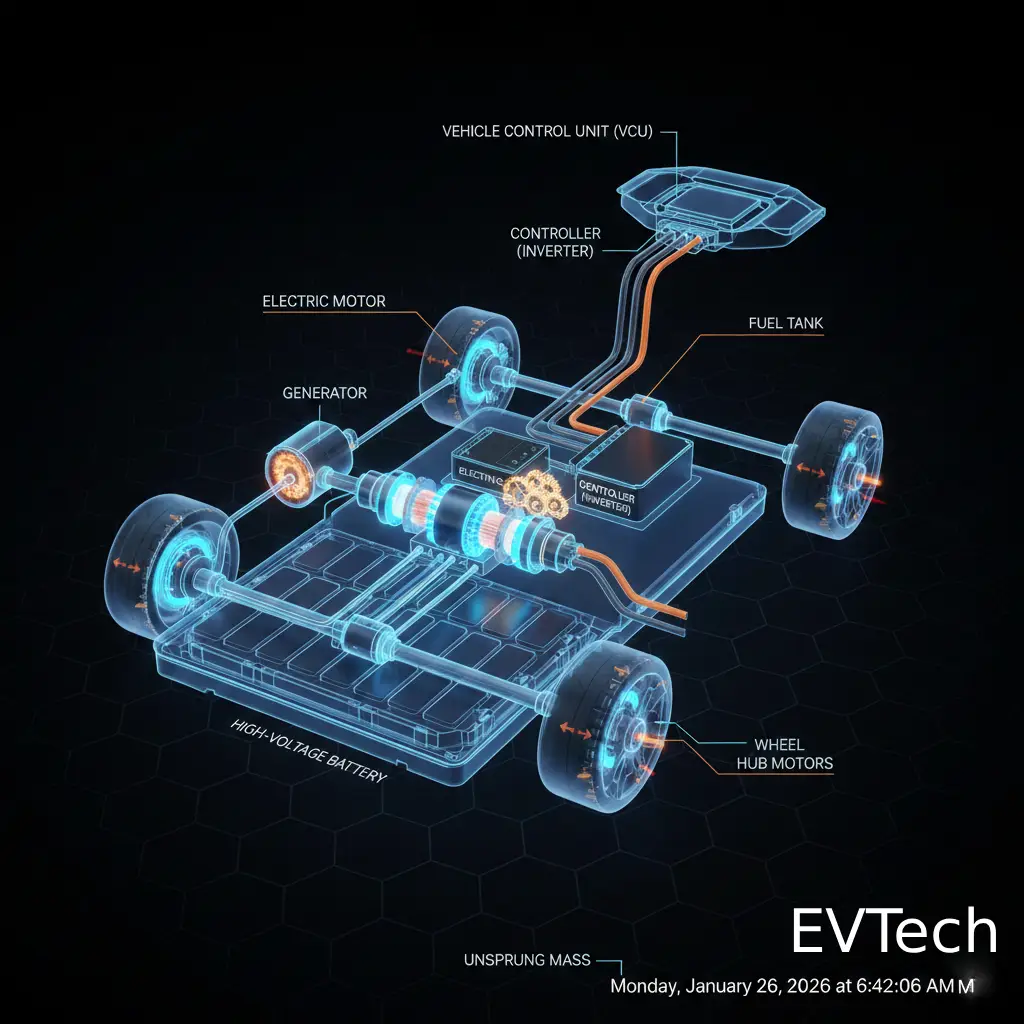
Under the precise command of the motor controller, the system converts electrical energy stored in the battery into mechanical energy. This process powers everything from moving forward and reversing to acceleration and braking.
Think of it like the human body: the electric motor acts as the “muscles,” generating power, while the transmission/drivetrain serves as the “skeleton,” transferring that power to the wheels. In Plug-in Hybrids (PHEVs) or Extended-Range EVs (EREVs), the system also includes a generator. This generator converts fuel into electricity through combustion, which then feeds the motor to drive the wheels alongside the main battery.
Components and How They Work
1. The Core Components An EV drive system typically consists of three main assemblies:
- The Electric Motor: The “beating heart” that converts electricity into rotational mechanical energy.
- The Controller: The “brain” of the system. It receives instructions from the Vehicle Control Unit (VCU) to manage the motor’s speed, direction (forward/reverse), and torque.
- The Reducer (Gearbox): Acting as a “torque multiplier,” the reducer uses gear sets to lower the motor’s high RPMs while increasing output torque, ensuring the car has enough power for uphill climbs and quick starts.
2. The Workflow Explained When you hit the accelerator, a seamless chain reaction begins: First, the Power Electronics (Inverter) takes DC power from the battery and “flips” it into AC power for the motor. Next, this AC power flows into the motor’s stator windings, creating an electromagnetic field that spins the rotor at high speeds—much like an electric fan. Finally, this high-speed rotation is sent through the reducer, which fine-tunes the speed and boosts the torque before delivering it to the wheels for a smooth, powerful ride.
Types of Electric Motors: Pros and Cons
The motor’s performance defines the driving experience. Here are the primary types used in today’s market:
A. Permanent Magnet Synchronous Motors (PMSM) This is the “gold standard” for many EV manufacturers. It uses high-grade permanent magnets to create a constant magnetic field.
- Pros: High power density and torque, compact size, and excellent energy efficiency, which helps maximize driving range.
- Cons: Higher cost due to the use of rare-earth materials. There is also a risk of “demagnetization” under extreme heat or current.
B. Induction (Asynchronous) Motors These motors create a magnetic field through induction rather than magnets.
- Pros: Very robust and reliable. There’s no risk of demagnetization, and they are generally cheaper to manufacture due to simpler construction.
- Cons: Slightly lower energy efficiency and lower power density, meaning they can be heavier and bulkier for the same power output.
C. Externally Excited Synchronous Motors (EESM) Unlike permanent magnet motors, these use an external power source to create the magnetic field.
- Pros: Highly efficient and offer precise control over torque and speed, making them ideal for high-performance stability.
- Cons: Increased complexity and manufacturing costs. The additional components also mean higher long-term maintenance needs.
D. Hub and In-Wheel Motors These represent the future of modular design, where the motor is placed directly inside or next to the wheel.
- Pros: Allows for independent control of each wheel (Torque Vectoring). It makes switching between Front-Wheel, Rear-Wheel, and All-Wheel Drive incredibly easy and opens up more interior space.
- Cons: Currently very expensive and technically challenging. Placing the motor in the wheel increases “unsprung mass,” which can negatively impact ride comfort and handling. They are also more vulnerable to damage from road debris and vibrations.