The Critical Role of High-Voltage Interlock Systems (HVIL)
According to ISO 6469-3:2011 (Electrically propelled road vehicles — Safety specifications — Part 3: Protection of persons against electric shock), high-voltage (HV) components in electric vehicles must be equipped with an interlock device to ensure overall vehicle safety. Known as High-Voltage Interlock (HVIL), or the High-Voltage Interlock Loop, this critical safety feature uses a low-voltage electrical signal to monitor the integrity and continuity of HV components, cables, connectors, and controller covers.
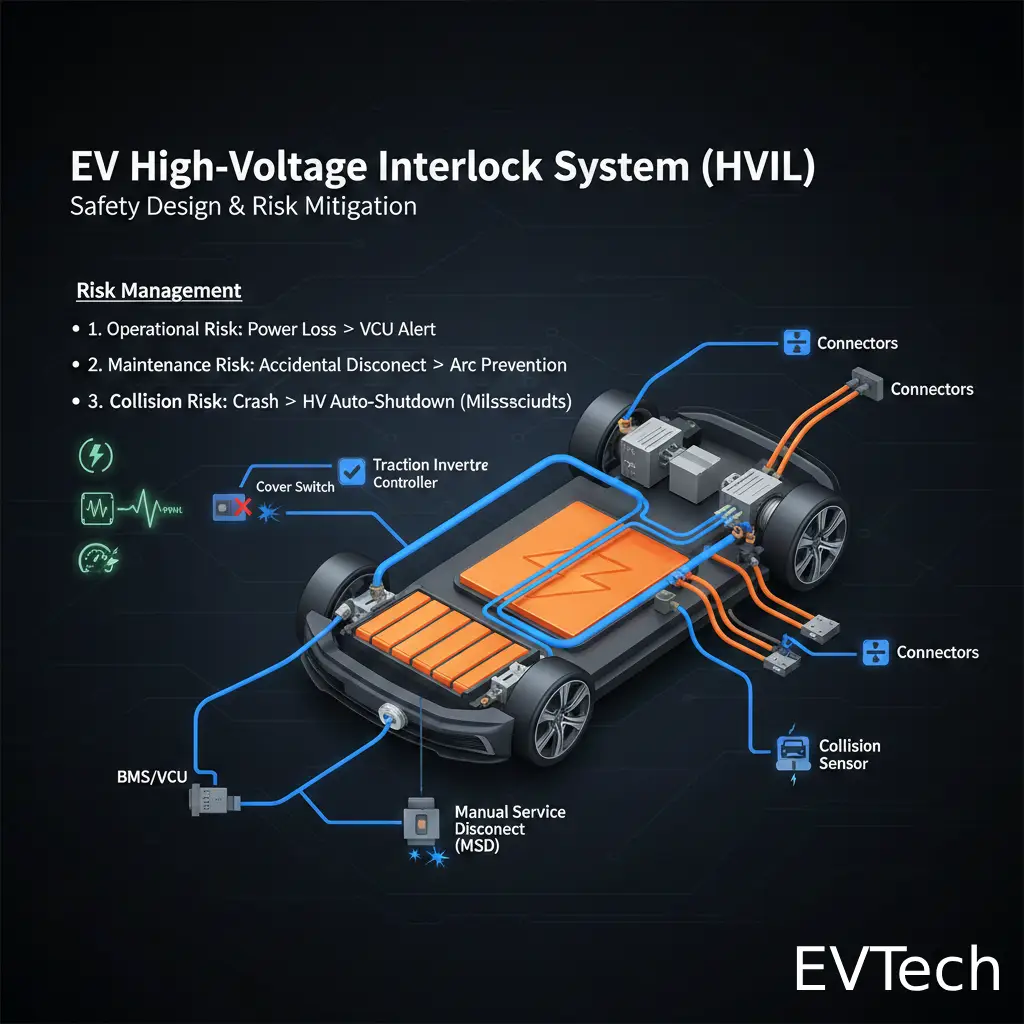
HVIL design is paramount in EV architecture. Beyond confirming that all HV components and wiring harnesses are properly seated without shorts or open circuits, the system integrates multiple safety layers: controller cover tamper detection, collision sensing, and Manual Service Disconnect (MSD) monitoring. Together, these functions provide comprehensive protection for the vehicle’s electrical environment.
How the HVIL System Functions
High-voltage controllers are equipped with limit switches (often called “cover switches”) that monitor in real-time whether service panels are securely closed. This adds a critical layer of safety for high-voltage environments.
A typical HVIL circuit consists of a closed electrical loop involving the Battery Management System (BMS) or Vehicle Control Unit (VCU), the low-voltage harness, and HV electrical equipment. In this architecture, the BMS or VCU acts as the “brain,” transmitting and receiving PWM (Pulse Width Modulation) signals to monitor loop continuity. If a short or open circuit is detected, the system immediately flags a potential safety risk and commands the high-voltage source to shut down, preventing hazardous operation.
Risk Management and Mitigation
❒ Operational Risks
Scenario 1: If a high-voltage failure occurs while the vehicle is in motion, the car could lose propulsion instantly. The HVIL system provides real-time monitoring of circuit continuity; if it detects a break, it sends an immediate alert to the VCU before total power loss. This allows the VCU to execute safety protocols and notify the driver, ensuring the vehicle remains controllable.
❒ Maintenance and Human Error
Scenario 2: During vehicle maintenance, if a technician accidentally disconnects an HV connector while the system is live, a massive high-voltage arc can occur, leading to severe injury or equipment damage. The HVIL system prevents this by sensing the disconnect and triggering a millisecond-fast shutdown of the traction battery, effectively “quenching” the potential for arcing.
❒ Collision Response
Scenario 3: In the event of a crash, collision sensors send a signal that triggers the HVIL shutdown protocol. This disconnects the entire high-voltage source within milliseconds, protecting occupants and first responders from electrical hazards.