As electric vehicles (EVs) become increasingly mainstream, safety has become a top priority for both consumers and manufacturers. Among the various safety features, Active High-Voltage (HV) Discharge is critical for preventing electrical hazards. Today, we’ll take a deep dive into how these systems work, exploring the different discharge methods, their technical principles, and their vital role in enhancing EV safety.
What is High-Voltage Active Discharge?
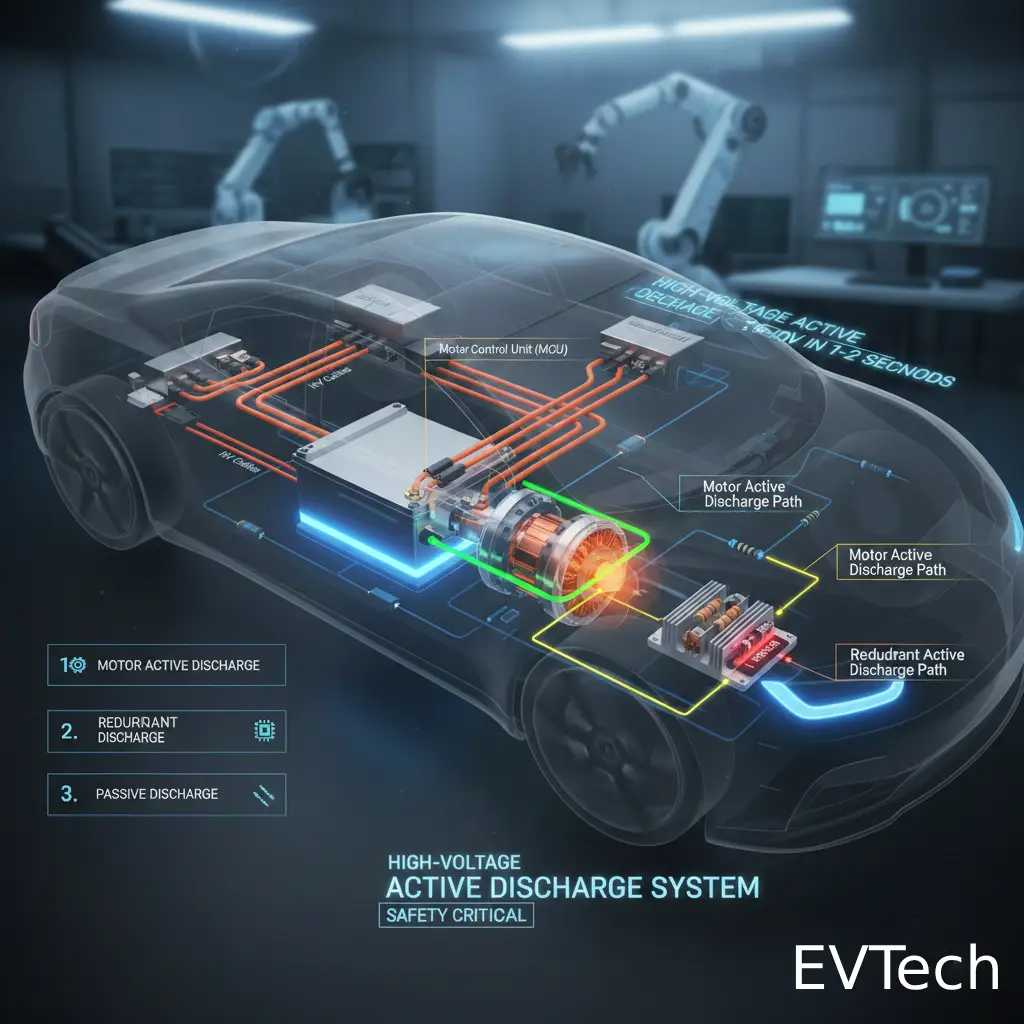
Active HV discharge is a process that occurs immediately after an EV’s high-voltage system is powered down. Using specialized discharge circuits and control logic, the system rapidly (usually within 1–2 seconds) bleeds off energy stored in high-voltage capacitors until the voltage drops to a safe level (typically below 60V).
The Core Objective: To eliminate the risk of electric shock or secondary hazards caused by residual voltage. This ensures the safety of personnel during vehicle maintenance, emergency response, or after a collision.
In the powertrain ecosystem, discharge methods are generally categorized into three types: Motor Active Discharge, Redundant Active Discharge, and Passive Discharge.
1. Motor Active Discharge (Active Discharge via Inverter)
Operating Principle:
This method uses the motor itself as a load to dissipate energy. The Motor Control Unit (MCU) manages the process; when a discharge signal is triggered, the MCU applies a specific control strategy to route energy into the motor windings.
Implementation:
The primary path is managed through torque control logic. By controlling the d-axis and q-axis currents, the DC-Link energy is released into the motor windings, where it is dissipated as heat.
Application Scenarios:
Standard vehicle shutdown, routine maintenance, or post-collision scenarios where the high-voltage system must be neutralized quickly.
Pros & Cons:
- Pros: Extremely fast discharge; highly flexible and intelligent via software control; requires no additional hardware.
- Cons: Since it shares the torque control path, improper calibration can cause torque ripple or slight vibrations, potentially affecting the “refined” feel of the vehicle during shutdown.
2. Redundant Active Discharge
Operating Principle:
Unlike motor discharge, this is a hardware-based backup. It relies on dedicated power electronics—such as discharge resistors or specialized circuits—to bleed off voltage. It is designed to act as a fail-safe if the motor discharge path fails.
Implementation:
This path utilizes a dedicated discharge resistor network controlled by a high-speed switch (like a MOSFET). The hardware includes the resistor bank, switching logic, and protection circuitry.
Application Scenarios:
Used to increase system reliability, particularly in severe crashes where the motor or inverter might be damaged. It also ensures the system reaches a safe state after long periods of inactivity.
Pros & Cons:
- Pros: Provides a critical extra layer of safety (redundancy); independent of motor status; high maintainability due to independent monitoring.
- Cons: Increases Bill of Materials (BOM) costs due to additional components. While reliable, the resistors can degrade over time with repeated thermal cycling, introducing a potential failure point.
3. Passive Discharge
Operating Principle:
Passive discharge is a “set it and forget it” mechanism. It doesn’t require active control logic; instead, it relies on permanently connected components—usually high-impedance resistors—that naturally drain the energy over time. It is much slower than active methods but is always “on.”
Application Scenarios:
Used as a background safety measure for when the vehicle is off and no other systems are active. It serves as the final line of defense if all active discharge systems fail.
Pros & Cons:
- Pros: Zero complexity; no software or sensors required; extremely low cost and high reliability.
- Cons: Slow. It cannot meet the 1–2 second safety window required for emergency situations.
Comparison Summary
| Method | Speed | Complexity | Reliability | Cost |
| Motor Active | Fast | High (Software) | High | Low |
| Redundant Active | Moderate | High (Hardware) | Very High | Moderate |
| Passive | Slow | Low | Highest | Minimal |