
With the rise of EVs, you’ve probably started hearing the term “Heat Pump” a lot lately. If you aren’t quite sure what that means—don’t worry, you’re not alone. Today, we’re going to break it down in plain English so everyone can get a clear picture of how it works.
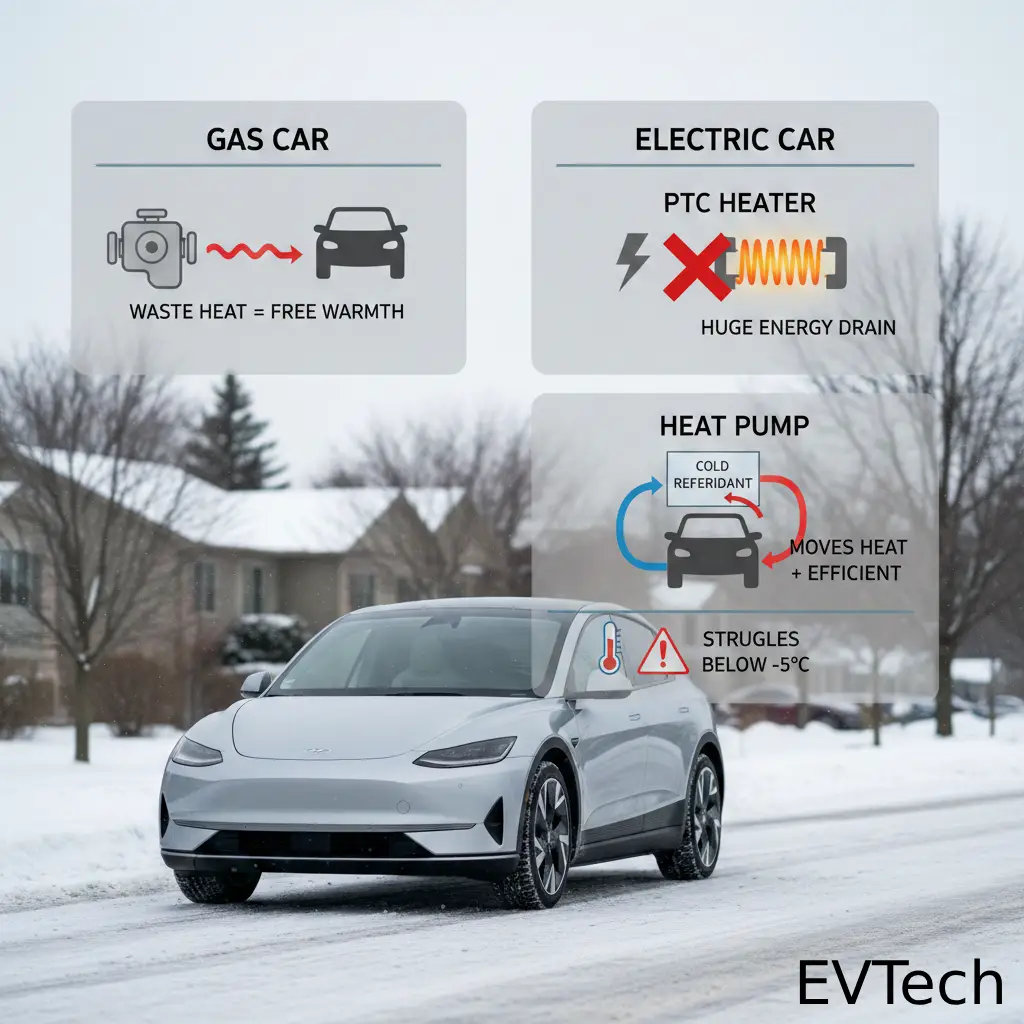
Before we dive in, let’s look at a quick baseline. In a traditional gas car, staying warm is “free.” The engine generates a massive amount of heat while running, and the car simply blows that heat into the cabin. You only really use the “AC system” in the summer to stay cool. Since EVs don’t have a giant internal combustion engine to keep them warm, things get a bit more complicated.
1. How Gas Cars Keep You Warm
As mentioned, gas cars use the engine’s coolant temperature. Once the engine hits its operating temperature (usually around 95°C), that heat is diverted to your vents. This is why you usually have to wait 3 to 5 minutes after a cold start before the air actually feels warm.
2. The Standard EV Method: PTC Heating
Most EVs currently on the road use PTC (Positive Temperature Coefficient) heaters. Think of this like a giant hair dryer or a space heater. It uses electricity from the battery to directly heat a coil, which then warms the air blown into the cabin.
- The Pro: It gets hot almost instantly.
- The Con: It is a massive power hog. Using a PTC heater kills your range, which is why many EV owners are afraid to blast the heat in the winter.
3. The Game Changer: Heat Pumps
A heat pump is essentially an air conditioner running in reverse. In the summer, an AC pulls heat out of the cabin and dumps it outside. A heat pump flips that process: it pulls heat from the outside air and “pumps” it into the cabin.
It uses a refrigerant cycle. Through the physics of latent heat (the energy released when a gas turns into a liquid), the system compresses refrigerant to create heat. That heat is blown into your car, while the cold byproduct is vented outside.
- The Pro: It’s incredibly efficient. Because it’s moving heat rather than creating it, it can improve winter range by up to 30%.
- The Con: It’s expensive. You’ll usually only find heat pumps on higher-end trims or premium EV models.
The Reality Check: The “Cold Floor” Problem
There is one catch: physics. A heat pump is a “heat mover,” not a “heat creator.” If the temperature outside drops too low (like those brutal -20°C or -40°C midwestern winters), there isn’t enough thermal energy in the outside air for the pump to grab.
Most heat pumps start losing effectiveness once you get below -5°C. This is why high-end EVs use a Hybrid System (PTC + Heat Pump). The heat pump handles the heavy lifting in mild cold, and the PTC heater kicks in like a backup generator when things get arctic.
The Bottom Line: A heat pump isn’t a furnace; it’s a “heat scout.” It’s great at finding energy and moving it around, but if the world outside is a frozen void, it needs a little help. Improving this technology remains one of the biggest challenges in automotive engineering today.



A really good blog and me back again.
This web site certainly has all the information I wanted about
this subject and didn’t know who to ask.
My partner and I stumbled over here from a
different web address and thought I should check things out.
I like what I see so now i’m following you. Look forward to looking into your web page
repeatedly.
magnificent issues altogether, you simply won a brand new reader.
What would you suggest in regards to your
put up that you made a few days ago? Any positive?
We stumbled over here by a different website
and thought I should check things out. I like what I see so now i’m following you.
Look forward to going over your web page for a second time.